

Supporting the Magic of Cinema – Behind the Scenes of Sharp’s Digital Cinema Projector Development
September 8, 2026
Enjoying movies at the cinema is always a magical experience – that big screen glowing in the dark quickly draws us into another world. While the movies and content play the leading role, that magical cinematic experience is also supported by technology that needs to project images with remarkable precision and stability.
At the heart of this experience is the digital cinema projector. Film projectors and earlier digital cinema projectors using lamp-based light sources were once the industry standard, but laser-based digital projectors are now the de-facto choice of the global cinema industry.. So what technologies and innovations lie behind the moviegoing experience?
We spoke with Sharp’s product planning and development team who work on bringing the magic of cinema to life by continually developing and enhancing digital cinema projectors. Through this article, we will hear from the development team who will provide their perspective and insight on the cinema experience, and ultimately help cinema owners better understand the operational reliability and potential of modern digital cinema projectors.
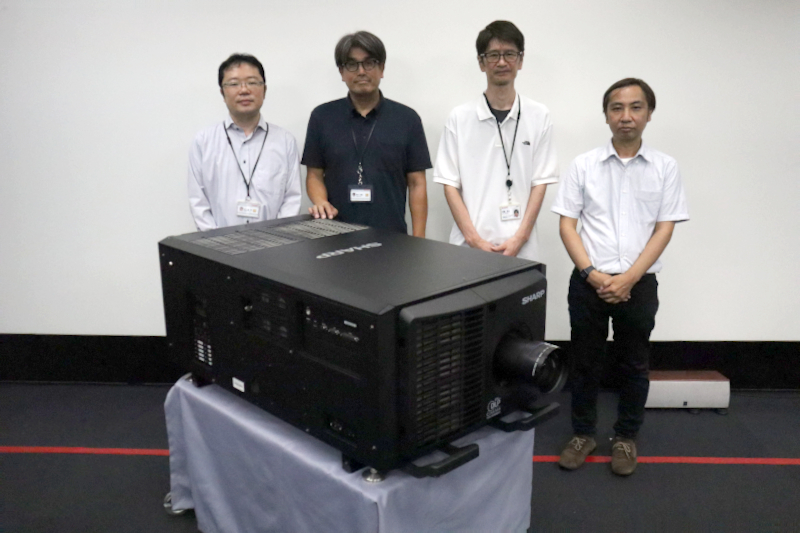
from left: Chikahisa and Suzuki (Product Planning Division), Saito and Oura (Development Team)
■The Unsung Hero: A Key Device That Audiences Never See
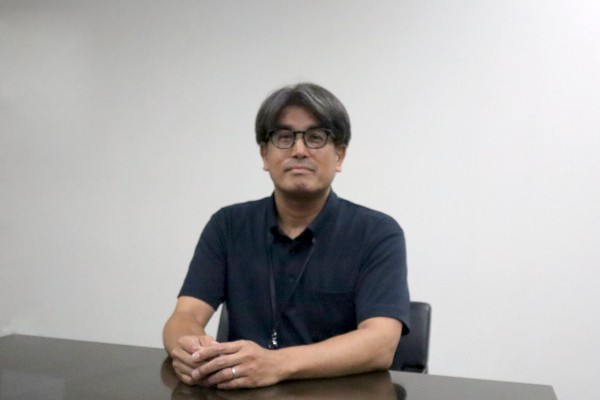
(Suzuki) Most moviegoers have never seen a digital cinema projector. Yet in the projection booth, these machines command a strong presence that makes movie screenings possible.
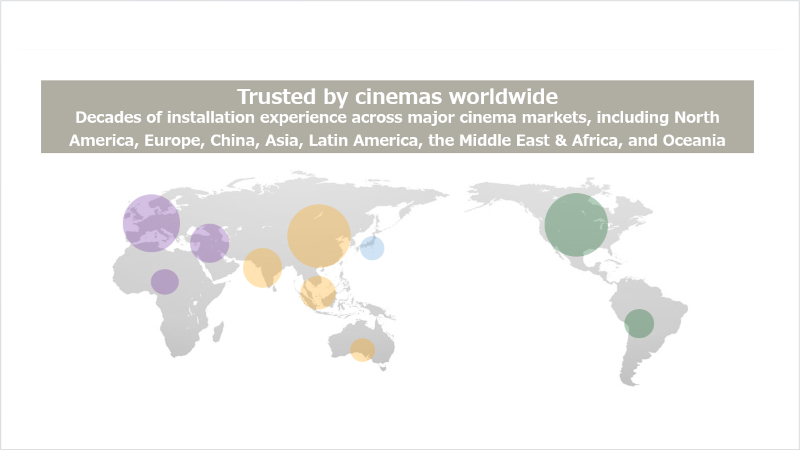
Sharp offers a wide lineup spanning compact models for smaller screens and Boutique Cinemas to units designed for the most demanding PLF (Premium Large Format) screens. Hidden from the audience’s view, these projectors are indispensable to delivering the cinema experience and are used around the world.
■What Is the Current State of the Cinema Market?
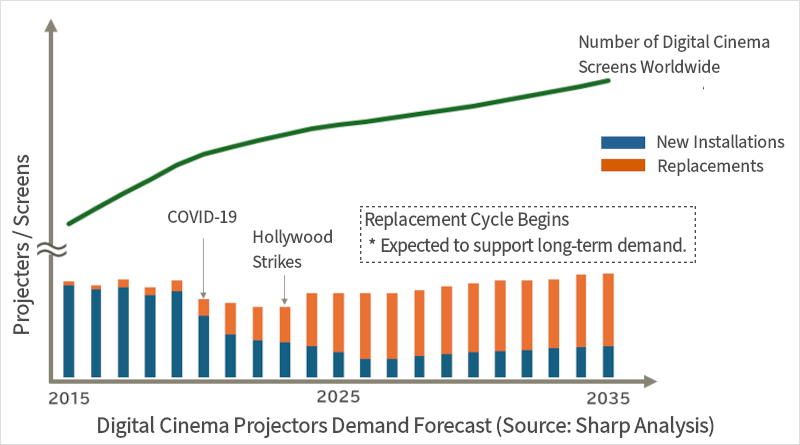
(Suzuki) The cinema market was severely impacted by the recent global pandemic. Box office revenues, which had been growing steadily through around 2019, fell sharply, and the digital cinema projector business was not immune to these effects.
Since the global pandemic, which had a huge impact on all areas of the cinema industry, , audiences have begun returning in significant numbers to cinemas, As the value of the in-cinema film experience is being reappraised, expectations for the equipment that supports screening quality have also risen.
Going forward, it is important to strengthen our relationships with current customers while responding to replacement demand and new installations. We plan to continue offering projector solutions tailored to each cinema’s challenges, and also be a key voice on emerging display technologies such as direct-view LED (dvLED) displays.
■The Global Standard for Digital Cinema

(Chikahisa) Screening a film at a consistent quality level in cinemas around the world requires strict standards governing image brightness, color, security, and more. The most representative of these is the DCI standard, defined by Digital Cinema Initiatives.
DCI was established primarily by major Hollywood studios to set technical specifications for digital cinema. Its purpose was to define the conditions required for the screening environment, with the goals of faithfully delivering the filmmaker’s intended imagery and appropriately protecting content.
Cinemas must comply with DCI standards in order to screen films from major studios. In other words, DCI compliance is an essential requirement for a digital cinema projector to be used in cinemas around the world.
Sharp’s DLP Cinema® projector series meets these rigorous standards while supporting exceptional image experiences suited to cinemas of various sizes and purposes.
Currently, only three companies globally—including Sharp—manufacture and sell DCI-compliant digital cinema projectors.
DCI-compliant digital cinema projectors require cinema technology from Texas Instruments—cinema-dedicated DLP *1 chips, circuits, and related technologies—and Sharp has held a license for this technology since 2002.
Note 1: DLP stands for Digital Light Processing and is the technology used in most modern laser-based digital cinema projectors. DLP chips incorporate a Digital Micromirror Device (DMD) consisting of an array of tiny movable mirrors. Light is controlled by changing the angle of each mirror.
● DLP and DMD™ are registered trademarks of Texas Instruments.
■How Phosphor Laser Light and DLP Technology Create Beautiful Images

(Oura) In a laser phosphor-based DLP system, two blue laser light sources are used: one is reflected off a phosphor wheel to generate yellow light, which is then combined with the other blue laser to produce white light. This light is split by a prism into red, green, and blue components, each of which is directed onto a DLP chip. The light reflected by each DLP chip passes through the prism and projection lens, coming together to form a single image on the screen.
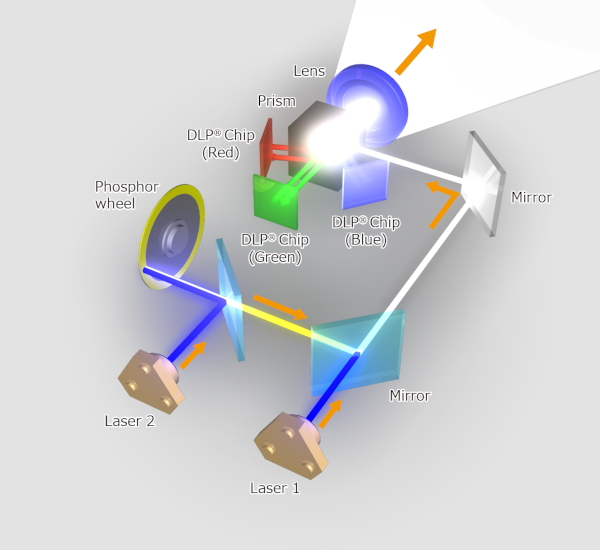
(Some models use a combination of blue and red laser light sources.)
Films are typically screened at 24 frames per second. Each DLP chip is covered with tiny movable mirrors, and the angle of each mirror is controlled at high speed to express fine gradations in brightness and color. The smooth, natural-looking motion that audiences experience is achieved through this continuous, precise control.
■Keeping the Show Running: Reliability and Serviceability as Development Priorities
(Saito) Equipment failure during a screening is a serious problem for any cinema. That is why reliability and serviceability are the top priorities in our development process.
If a failure does occur, cinemas need to restore operation before the next screening. In some cases, repair work must be carried out from late night into the early morning, putting significant pressure on the staff. It is therefore critical not only to design equipment that is less prone to failure, but also to ensure a structure that enables quick diagnosis and repair when something does go wrong.
Digital cinema projectors are devices that are expected to remain in service for many years . With long-term use in mind, it is necessary to plan and ensure the availability of replacement parts and compatibility with alternative components. To give cinemas the confidence to continue using our equipment over the long term, a design philosophy that encompasses long-term support is essential. Product performance alone is not enough.
■Managing Heat and Dust for Stable, Beautiful Images
(Saito) One of the major challenges in commercialization is ensuring that the red, green, and blue images are always precisely aligned. Even a slight misalignment can result in blurring or visual artifacts on screen. We design component mounting methods and cooling systems in detail while accounting for factors such as thermal expansion of parts.
The cooling system is broadly divided into two sections: the optical engine unit and the light source unit.
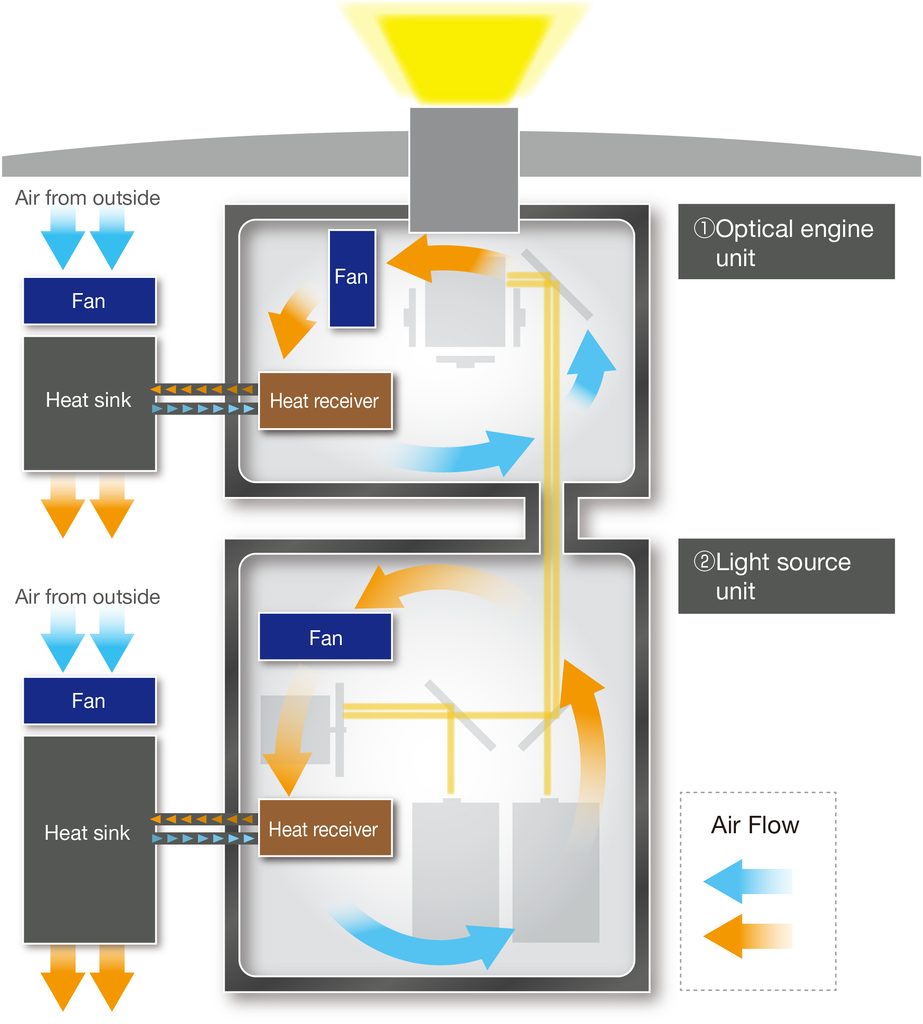
(Oura) If dust enters the light path, it can affect image quality and component lifespan. For this reason, the optical section is sealed to prevent dust infiltration. However, sealing the enclosure makes heat dissipation more difficult. That makes cooling technology critically important. Sharp uses heat-pipe heat sinks and liquid cooling to efficiently transfer internal heat to the outside, helping maintain stable screening quality.
■Pursuing Compact Size, Quiet Operation, and Ease of Use for Future Cinemas
(Suzuki) Digital cinema projectors have traditionally been installed in dedicated projection booths, and their larger size was to some extent accepted as a trade-off for maximum reliability. However, cinemas vary greatly in scale and installation environment. In small and medium-sized cinemas in particular, there is a growing trend toward installing projectors directly in the auditorium rather than in a separate projection room, creating demand for equipment that is easier to handle, quieter, and more reliable.
Going forward, we aim to expand our lineup with products that maintain high reliability while achieving even greater compactness, quieter operation, enhanced dust resistance, and improved maintainability. Greater flexibility in equipment placement will also contribute to more efficient use of space within the cinema. Our goal is to deliver a comfortable moviegoing experience to a wider audience, while also contributing to improved profitability in cinema operations.
——Thank you very much.
The beautiful images that appear so naturally on the screens are made possible by a commitment to faithfully delivering the filmmaker’s vision and by years of accumulated technological expertise. So the next time you sit back and wait for a film to begin, please take a moment to think about the projector quietly at work in the projection booth behind you. Although you will not see it directly, it helps create the magic of cinema every day.
(Public Relations C)
Product Information
Japan: Under construction
Americas: https://business.sharpusa.com/digital-cinema-solutions